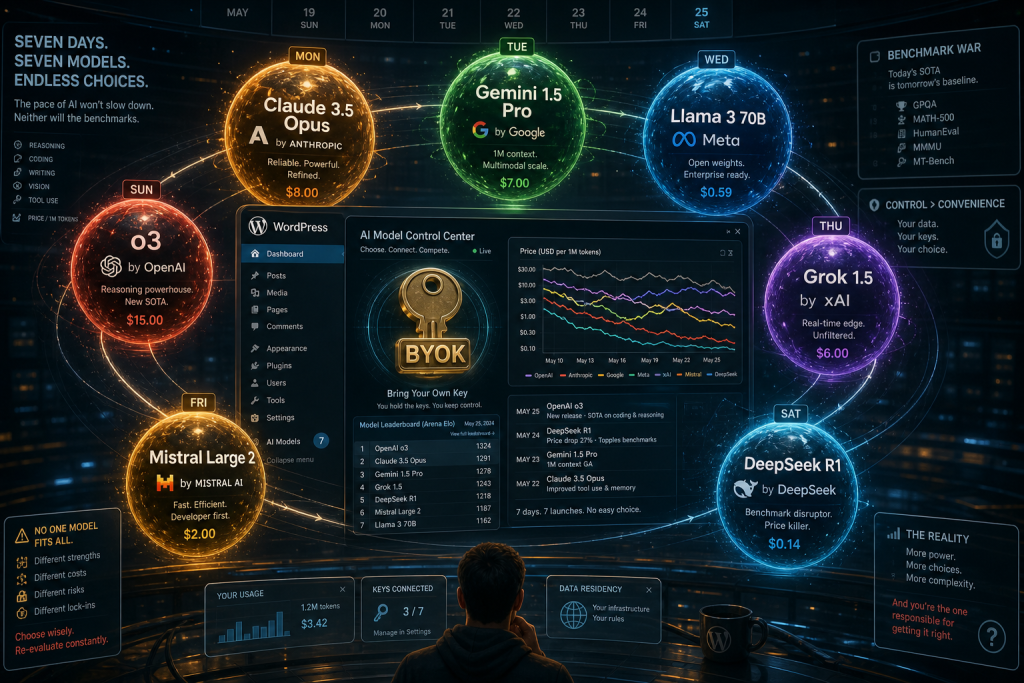
Between September 1 and September 7, 2026, seven major AI models entered production. Claude Fable 5.1 dropped on the 1st. Gemini 3.8 Flash arrived on the 2nd. GPT-6 Astra shipped on the 3rd. Claude Mythos 5.1, Tencent’s HY4 Preview, and Meta’s Muse Spark 1.3 followed immediately after.
Seven releases in seven days reset pricing baselines and shifted reasoning benchmarks across every major provider. Yet most WordPress site owners running AI plugins did not change a single setting.
A bring-your-own-key (BYOK) setup is only as effective as your willingness to revisit your model choices. When you treat model selection like SMTP settings—configured once during setup and forgotten—you lose the entire financial and technical advantage of bringing your own keys.
The Cost of Set-and-Forget Architecture
The primary benefit of BYOK architecture is direct control. You supply your own API credentials, pay provider rates directly without middleman markups, and pick the exact model running on your site.
The problem is operational inertia. A model selected six months ago remains active indefinitely, even when newer options offer faster response times at a fraction of the cost.
The September 2026 release cluster widened the efficiency gap between model tiers:
- GPT-6 Astra and Claude Fable 5.1: Premium reasoning tiers suited for deep context analysis and multi-step execution.
- Gemini 3.8 Flash: High-throughput utility tier priced significantly lower per token, built for immediate response generation.
If you route every visitor query through a frontier reasoning model, you overpay for simple tasks like answering store hours or summarizing a blog post. If you downgrade your entire site to a budget tier, your backend automation fails on complex administrative tasks.
One Model Cannot Serve Two Distinct Roles
WordPress AI workflows split into two separate operational profiles with conflicting requirements.
The Public Chatbot Profile:
A visitor-facing chatbot handles high volume. Its primary constraints are latency and cost per conversation. Visitors expect immediate answers, and queries rarely require deep logical deduction. Routing basic FAQ traffic through an expensive reasoning model increases API bills without improving visitor experience.
The Admin Agent Profile:
An internal admin agent handles complex site maintenance, content drafting, and multi-step tool execution. Its primary constraint is reliability. A failed function call or inaccurate response in the WordPress dashboard wastes editorial time and breaks workflows. Admin agents require frontier reasoning capabilities where higher per-token costs are justified.
Forcing both tasks through a single global model setting creates an immediate compromise: you either overspend on routine visitor chats or degrade the quality of your backend automation.
Decouple Your AI Tasks with Per-Agent Model Selection
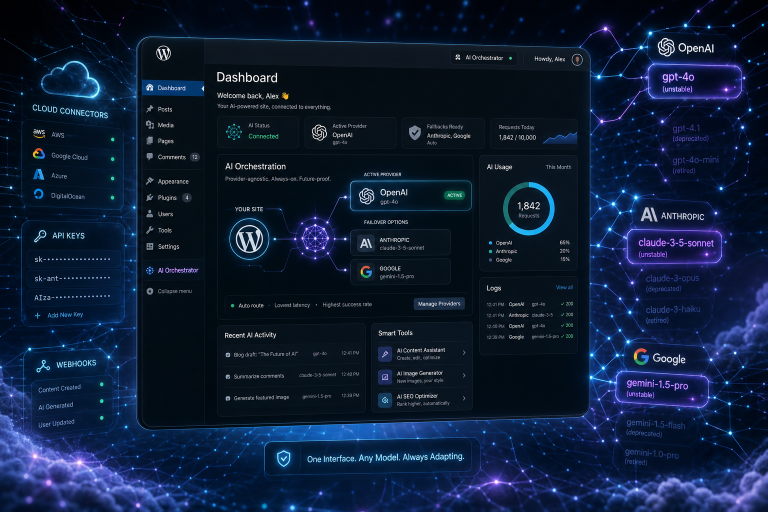
The solution is assigning models based on the specific job. PressBot Pro includes per-agent model selection, allowing you to run different providers and tiers for your front-end chatbot and your backend admin agent.
This separation gives you practical control over your setup:
- Assign Gemini 3.8 Flash to the visitor chatbot: Keep per-interaction costs low and maintain fast response times for public visitors.
- Assign Claude Fable 5.1 or GPT-6 Astra to the admin agent: Provide high-accuracy tool execution and reasoning for complex administrative tasks in your dashboard.
- Swap models instantly when the market changes: When a provider drops prices or ships a faster alternative, change the model dropdown for that specific agent in two clicks without touching the rest of your site.
Audit Your Active Models Today
Model pricing and capabilities move quickly. If you configured your WordPress AI settings months ago, your current setup is out of step with current pricing and speed benchmarks.
Log into your WordPress dashboard, check your active model selections in PressBot, and align your models with their specific tasks. Upgrade to PressBot Pro to enable per-agent model selection and run different models for your chatbot and admin workflows.