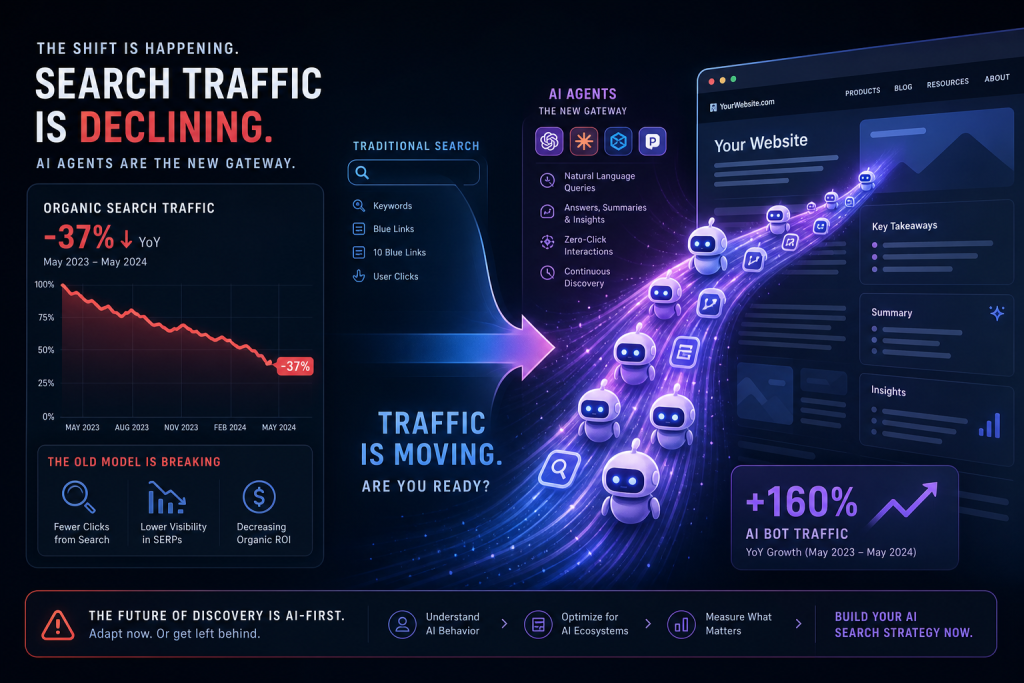
Google traffic to publishers dropped 33% in 2025. In the same period, AI search referrals grew 1,200%. If your WordPress site’s organic traffic flatlined last year, this is probably why.
The bots reading your content have changed. GPTBot more than doubled its crawling share in the past year, rising from 4.7% to 11.7% of AI crawl traffic. ClaudeBot went from 6% to roughly 10%. OpenAI’s crawlers alone now account for about 69% of all observed AI-driven traffic. And these agents aren’t behaving like the Google crawler you optimized for. They scan, extract, and cite. They don’t click through, browse your sidebar, or spend three minutes reading your long-form guide.
The contrast matters: humans click, agents extract.
The 2024 Playbook Was Built for Humans
Think about what WordPress SEO looked like in 2024. Long-tail keywords in H2s. Internal linking clusters to boost time on site. Engagement signals like scroll depth and dwell time. All of that was optimized for a human visitor who arrives from a search result, reads content linearly, and hopefully clicks deeper into your site.
AI agents don’t do any of that. Anthropic’s crawlers hit 10,347 pages for every single referral they send back to the source. They’re consuming your content in bulk and returning almost nothing in the form of traffic. What they do return, though, is citations. And citations in AI-generated answers are worth something real: brands cited in AI Overviews earn 35% more organic clicks and 91% more paid clicks.
The problem is that most WordPress sites are still writing marketing copy aimed at these agents and wondering why the citations go to Wikipedia, product documentation, and Stack Overflow instead.
Agents Quote Facts, Not Flair
Here’s what we’ve observed in citation patterns: 44.2% of all LLM citations come from the first 30% of a piece of content. That’s your introduction and opening sections. If those sections are filled with brand voice fluff, narrative hooks, and emotional appeals, there’s nothing for an agent to extract. It moves on to a source that gives it a clean, quotable fact.
AI agents identify entities, not keywords. ChatGPT favors content organized with clear headings, bullet points, and concise paragraphs that it can extract and summarize without paraphrasing. It doesn’t care about your keyword density. It cares whether your content contains a discrete, structured answer to a question someone asked.
Consider two versions of the same content on a WooCommerce product page:
Version A (marketing copy): “Our premium hosting solution delivers blazing-fast performance that your visitors will love, backed by our award-winning support team.”
Version B (structured fact): “Starter plan: 10GB SSD storage, 25,000 monthly visits, daily backups, free SSL. Support response time: under 2 hours on business days. $12/month billed annually.”
Version B gets cited. Version A gets skipped. The agent needs something it can quote directly, attribute to your domain, and present as a factual answer. Marketing copy fails that test every time.
Treat Your Site Like Documentation
We think the fix is straightforward, even if it requires a mindset shift. Stop writing exclusively for persuasion and start writing for extraction.
That means:
- Lead with facts, not hooks. Put your most quotable, specific information in the first few paragraphs. Specs, pricing, capabilities, supported platforms. The data that answers a question without requiring the reader to scroll.
- Use clean structural hierarchy. H2s that are actual topic labels, not clever wordplay. H3s that break down subtopics. Bullet lists for feature sets, specs, and comparisons.
- Build an explicit knowledge base. Dedicated pages with clear, factual content about your product, service, or expertise. FAQ pages with real questions and direct answers. Glossary entries for terms you want to own in AI responses.
- Write content an agent can quote without paraphrasing. If your sentence only makes sense with the surrounding paragraph, it’s not extractable. Self-contained, declarative statements get cited.
This doesn’t mean abandoning your brand voice or your human audience. It means adding a layer. Your blog post can still tell a story, but your product pages, documentation, and knowledge base entries should be structured for machine extraction first.
The Small Traffic That Converts
There’s a silver lining in the data. AI-referred traffic converts at dramatically higher rates than organic search: ChatGPT referrals convert at 15.9%, Perplexity at 10.5%, compared to Google organic at 1.76%. Visitors arriving from AI platforms aren’t browsing. They’ve already done their research inside the AI interface. They’re coming to your site to act.
That makes getting cited even more valuable per visit than a traditional organic click. Fewer visitors, but the ones who arrive are ready to buy, sign up, or commit.
What We’re Building for This
This shift is exactly why we built the Knowledge Base in PressBot the way we did. It’s markdown-native and exposed as MCP resources, which means AI agents can read it directly. Your knowledge base content isn’t hidden behind JavaScript rendering or gated behind login walls. It’s structured, accessible, and built for the way agents actually consume information.
We also shipped the AI Visibility Opportunity Engine in PressBot 1.6.5 specifically to help WordPress sites identify where they’re missing citations and what structured content would close the gap. If your traffic flatlined in 2025 and you’re still running the old playbook, those two features are where we’d start.
Take a look at your site’s content through the lens of an agent, not a reader. The sites that adapt to this shift will earn the citations. The ones that don’t will keep wondering where the traffic went.