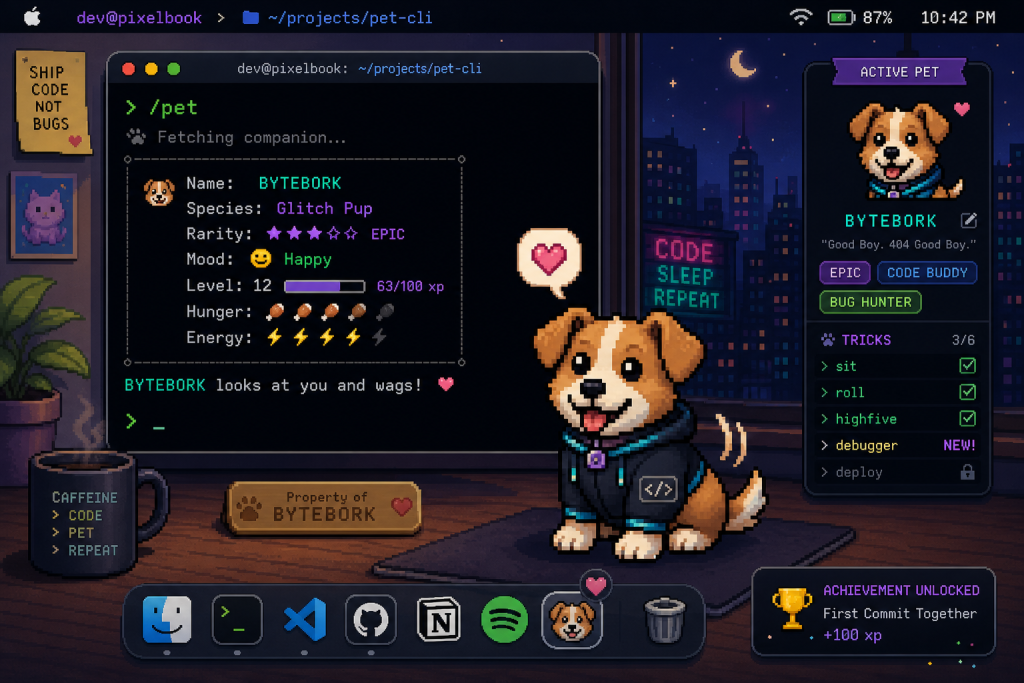
OpenAI just shipped a feature that lets you hatch a small pixel pet inside your coding environment. Codex ships with eight predefined pets in a pixel-art style out of the box, and you can hatch custom ones on top of that. Each one sits near your taskbar or Dock, with a personality trait, a rarity level, and a mood. You can name it whatever you want. Developer Dominik Kundel fed a photo of his actual dog into the hatch-pet skill and got back a Codex pet that looked like his real dog. (OpenAI’s own marketing leaned on a pixel dog named “Meme” as the example, but it’s not a default — it’s just the one they showed off.)
This is a feature for a professional coding agent. And developers are eating it up.
What Codex Pets Actually Does
The /pet command in Codex surfaces small, animated companions on both Windows and macOS. Type it, and a creature appears near your taskbar or Dock. You pick from eight built-in pets, each with a profile card showing species, personality, rarity, and mood. You can also create custom ones — either by running the /hatch command directly, or by installing the hatch-pet skill and prompting it (e.g. $hatch-pet create a new pet inspired by my recent projects) to generate something tied to your actual work.
But here’s the part that makes it more than a toy: the pet overlay doubles as a status indicator. It reflects whether Codex is running, waiting for input, or ready for review, and pairs that state with a short progress prompt. The overlay stays visible while you use other apps, keeping your active Codex thread in your peripheral vision without demanding a tab switch.
An OpenAI developer on the project put it plainly: “Pets adds a little more whimsy to Codex, but it is also useful.”
Why “Small” Features Punch Above Their Weight
Product teams tend to prioritize capability. Faster inference, better reasoning, larger context windows — these are the metrics that fill benchmark tables and investor decks. But users are not benchmark tables. Users are people who spend eight hours a day staring at a tool, and they notice when that tool has no personality.
Codex Pets costs OpenAI almost nothing in engineering terms relative to training a new model. Yet it does something a 10% improvement in code completion accuracy cannot: it gives people something to talk about. It gives them something to screenshot, share on X, and show a coworker. It makes the tool feel like theirs.
This pattern repeats across software history. Slack’s custom emoji and loading messages. GitHub’s contribution graph. Discord’s entire identity. None of these are core functionality. All of them are reasons people chose those platforms over technically equivalent competitors.
Personalization as a Retention Strategy
Codex also now offers personality settings — Friendly, Pragmatic, or None — plus custom instructions users can define at any time. Combined with pets, this signals a deliberate shift: OpenAI is treating the developer experience as something to be owned by the user, not just consumed.
This matters because AI coding agents are converging on capability. Codex, Claude Code, Gemini Code Assist, Cursor — they all write decent code, they all handle multi-file edits, they all understand context. When the core product is approaching parity, the differentiator moves to how the tool feels. Personalization creates switching costs that technical specs alone cannot. Nobody migrates away from a tool that has their dog in it.
The psychology here is straightforward. People anthropomorphize tools they spend time with. Give them a name, a face, a personality toggle, and the tool stops being interchangeable infrastructure. It becomes a companion. That is not sentimentality — it is retention math.
The Anthropic Precedent
Anthropic tried something adjacent with Claude Code Buddy, released April 1, 2026 and quietly pulled on April 9. Buddy leaned into Tamagotchi-style nostalgia — more entertainment than utility. Codex Pets learned from that. By tying the pet’s visual state to actual agent status, OpenAI turned the concept from a novelty into a lightweight monitoring tool. The whimsy is still there, but it earns its screen space.
That distinction matters. Anthropic’s removal of Buddy after eight days suggests they recognized the feature lacked functional justification. OpenAI took the same impulse and gave it one.
What This Means for Competitors
Google, Anthropic, and every startup building AI developer tools now face a question that has nothing to do with model quality: does your product have a personality?
If the answer is no, you are competing purely on benchmarks in a market where benchmarks are tightening. Codex Pets is OpenAI signaling that they understand developer affinity is built in the margins — in the moments between tasks, in the idle animations, in the small choice to name something “Meme” instead of “Agent Process 7.”
Competitors who dismiss this as frivolous will miss the point. The feature is not the pet. The feature is the feeling that this tool is mine.
The Takeaway for Anyone Building AI Products
If you build tools that people use daily, personalization is not a nice-to-have. It is infrastructure for loyalty. A custom name, a configurable personality, a visual identity the user chose — these things compound. They turn a user into an advocate.
This applies well beyond coding agents. Any AI-powered product — whether it manages a WordPress site, handles customer support, or generates content — benefits from giving users a sense of ownership over how it behaves and presents itself. Features like a WordPress chatbot you can personalize with configurable bot names, custom avatars, personality modes, and appearance theming are not decoration. They are the reason someone stays when a competitor launches a slightly faster model.
OpenAI just proved you can ship a pixel pet and move market sentiment. That is worth paying attention to.
If that ownership instinct resonates, try a WordPress chatbot built for ownership.