The AI landscape has evolved dramatically, and WordPress users now face an exciting choice between traditional chatbots and revolutionary AI agents. While both technologies serve important roles, understanding their fundamental differences can transform how you manage your website and engage with visitors.
What Makes AI Agents Different from Traditional Chatbots?
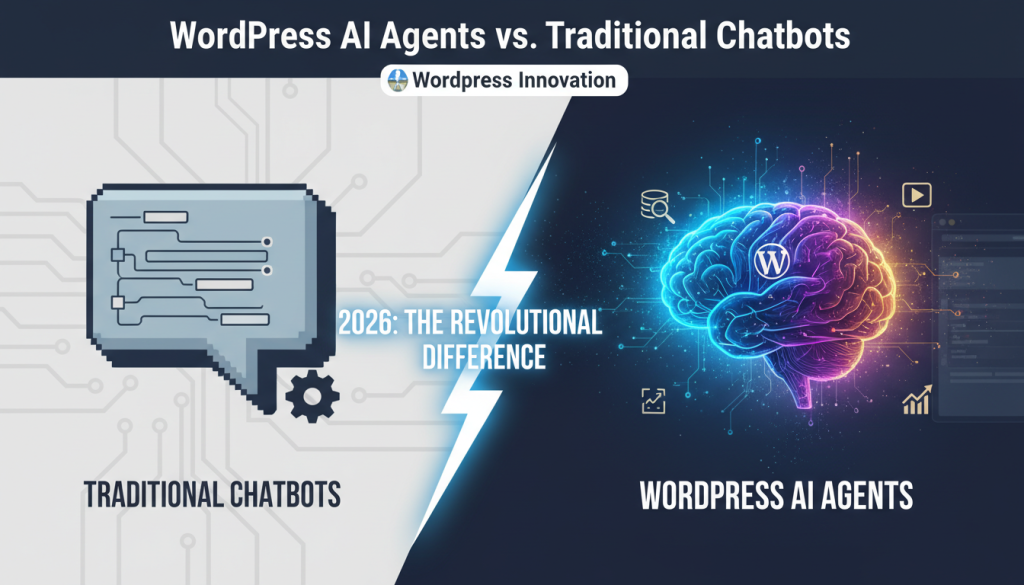
Traditional chatbots are designed to respond to user queries with pre-programmed answers or knowledge base information. They excel at customer service, answering frequently asked questions, and providing round-the-clock support to website visitors. However, their capabilities are typically limited to conversation and information retrieval.
AI agents represent a significant advancement in WordPress management. These intelligent assistants can perform actions within your WordPress admin dashboard through natural language commands. Instead of just discussing your website, they can actively help you manage it.
The Power of Natural Language WordPress Management
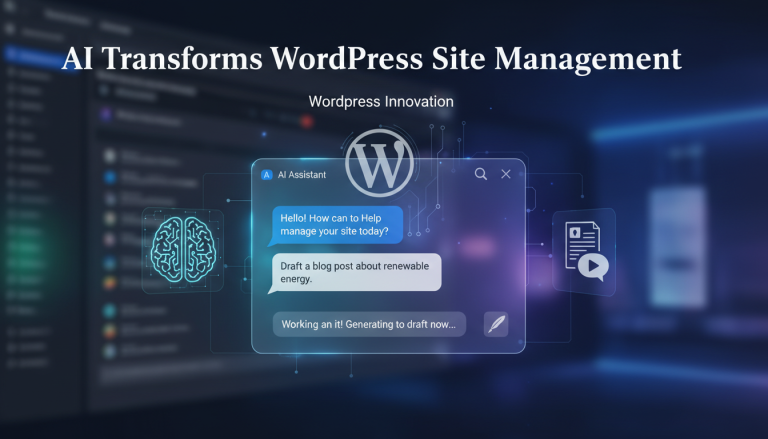
Consider the possibility of telling your WordPress site, “Create a draft post about our latest product features,” and having it automatically generated within seconds. AI agents make this possible by combining conversational interfaces with actual WordPress functionality.
Modern AI agents can execute WordPress actions including:
- Creating and updating posts and pages
- Managing categories and tags
- Analyzing site performance data
- Performing content research
This natural language approach to website management can eliminate the need to navigate through multiple admin screens and remember specific procedures.
Dual-Mode Operation: Best of Both Worlds
Advanced WordPress AI solutions now offer dual-mode operation, combining both chatbot and agent capabilities. This approach typically includes a public chatbot mode for visitor engagement and an admin agent mode for site management.
The public chatbot mode functions as a customer service tool, answering visitor questions based on your knowledge base and providing continuous support. Meanwhile, the admin agent mode serves as a WordPress assistant that can create content, manage site elements, and analyze data through conversational commands.
Advanced Features Shaping 2026
Today’s AI agents often support multiple AI providers like Anthropic Claude and Google Gemini, allowing you to choose the model that best fits your needs. Claude models are particularly well-suited for complex administrative tasks due to their advanced tool-calling capabilities, while Gemini can offer budget-friendly options.
Web search integration represents another valuable feature, enabling AI agents to research current trends, find up-to-date information, and create content based on real-time data. This capability bridges the gap between your website’s existing knowledge and the broader internet.
Practical Implementation Considerations
When choosing between chatbots and AI agents, consider your primary objectives. If visitor engagement and customer support are your main goals, a traditional chatbot might be sufficient. However, if you want to streamline WordPress management and leverage natural language commands for content creation and site administration, an AI agent offers significantly more functionality.
The bring-your-own-key (BYOK) model has become increasingly popular, giving you direct control over costs and privacy with AI providers. This approach can eliminate recurring subscription fees while providing transparency in usage and expenses.
Looking Ahead
As AI technology continues advancing, the distinction between simple chatbots and intelligent agents will become even more pronounced. WordPress users who embrace AI agents position themselves to benefit from efficient, natural language-driven website management.
The future of WordPress lies in tools that understand context, execute actions, and adapt to your workflow—making AI agents a valuable investment in both current productivity and future capabilities.