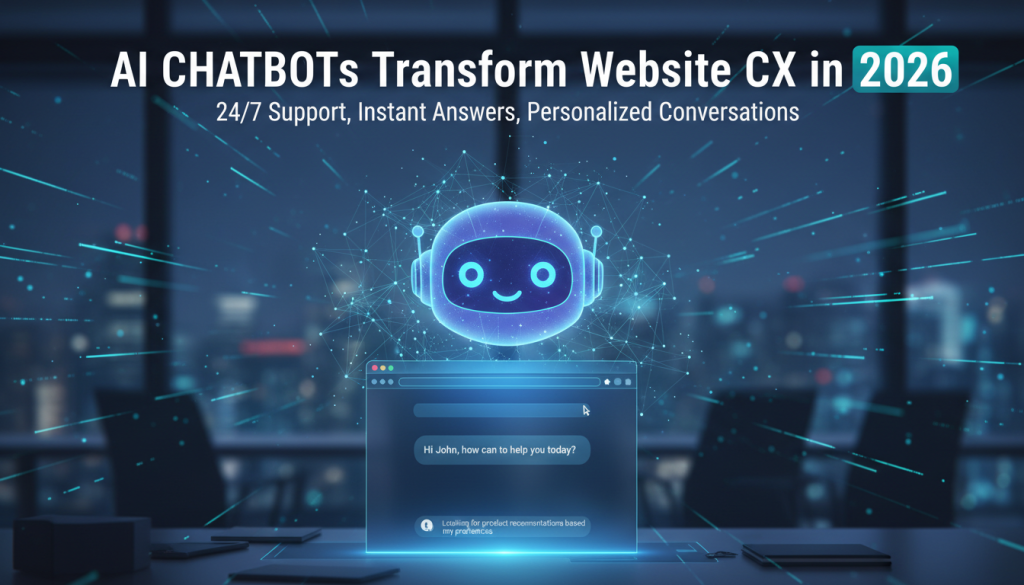
Your website visitors have questions, and they expect answers now. A potential customer browsing your services at 2 AM will not wait for your team to start work. This demand for immediate interaction makes AI-powered chatbots a fundamental component of any successful website in 2026.
AI chatbots engage customers 24/7, delivering instant responses that guide them through your sales process. They replace the delays of email and contact forms with interactive, helpful conversations.
The Core Advantage: Immediate, Always-On Support
Speed and availability are the foundation of a positive customer experience. When visitors have questions about pricing, features, or services, they need answers in seconds. An AI chatbot delivers, preventing the frustration that causes high bounce rates.
Traditional support channels create bottlenecks. Email takes hours, and phone support has limited availability. A chatbot operates without these constraints, handling multiple conversations simultaneously, any time of day. This 24/7 presence captures leads from visitors in different time zones, or those browsing on evenings and weekends, who would otherwise leave your site without the information they need.
Beyond Basic Answers: Delivering Quality and Context
Modern AI chatbots provide more than just speed; they deliver relevance. The chatbot analyzes visitor behavior to offer targeted help. If someone is viewing your pricing page, it offers to explain the different plans. If they are in your support section, it asks if they need help finding a specific article.
The quality of these interactions depends on a comprehensive knowledge base. By uploading detailed information about your products, services, and policies, you equip the chatbot to give accurate, specific answers. For a consulting firm, this means uploading service descriptions and pricing. When a visitor asks, “What marketing consulting do you offer?” the chatbot provides precise details, transforming it from a simple FAQ tool into an intelligent assistant.
Integrating AI into Your Business Workflow
While AI handles most routine inquiries, complex issues still require human expertise. A well-designed chatbot process creates efficient transitions to your support team. When a question is beyond its scope, the chatbot collects the customer’s details and the full conversation context, creating a support ticket. This preparation eliminates the need for customers to repeat themselves and allows your team to resolve the issue faster.
Every conversation also generates valuable data on customer needs and pain points. Analyzing these logs reveals what questions your customers ask most, what information is missing from your website, and where friction exists in your sales process. This insight allows you to improve your site content and product documentation directly based on user feedback.
Implementation and Measurement on WordPress
For WordPress sites, AI chatbots are integrated via plugins that provide a visitor-facing chat widget and an admin dashboard. Look for solutions that support multiple AI providers, such as Anthropic Claude or Google Gemini, giving you flexibility on cost and quality. Setup involves adding your AI provider’s API key, uploading your knowledge base, and customizing the chatbot’s appearance to match your brand.
To evaluate the chatbot’s impact, track key metrics like response times, conversation completion rates, and customer satisfaction scores. Compare website conversion rates before and after implementation to measure the direct business results. Analyzing which questions require human intervention also helps you refine the knowledge base, continuously improving the AI’s performance.
To implement an AI chatbot effectively, start by auditing your current support process. Identify the top 5-10 questions your visitors and customers ask. Use these questions as the foundation for your chatbot’s knowledge base to ensure it has an immediate and measurable impact on customer satisfaction and your business goals.